
-
AAPSU member hurt as situation turns volatile during SIR…
-
NEC completes landmark projects worth over ₹ 82 …
-
Borguli residents seek permanent flood protection as Siang erosion…
-
Governor extends Teachers’ Day greeting
-
DLMC meeting reviews developmental schemes in Tawang
-
Ziro Administration gears up for Ziro Music Festival 2026
-
AIIMS Guwahati, TRIHMS organises systematic review and meta-analysis workshop
-
State Congress stage protest demanding withdrawal of FIR against…
-
AAPSU welcomes APPSC move to implement uniform eligibility criteria in…
-
17 metric tonnes buckwheat sourced from women farmers shipped to…
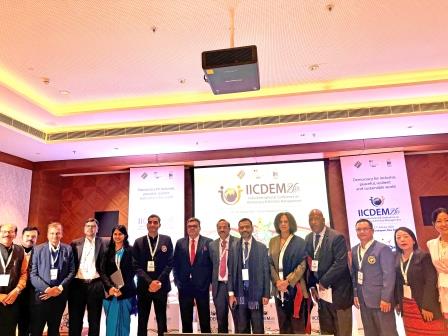
New Delhi, Jan 21: Team Arunachal Pradesh participated in IICDEM 2026 by leading the thematic session on “Political Parties and Candidates.” The session was set in motion by Pawan Kumar Sain, Chief Electoral Officer of Arunachal Pradesh, who provided a contextual overview and outlined the key aspects of the theme. He also moderated the remaining presentations, ensuring a smooth flow of discussions.
Next in line was Ms. Anne Marel Linger, Member of the OKB, Suriname, who delved into comparative perspectives on political party frameworks and candidate engagement in her jurisdiction, highlighting global best practices and lessons for emerging democracies.
Following her, Masego Sheburi, Deputy Chief Electoral Officer of South Africa, shared valuable insights through his presentation. Drawing on his experience, he discussed how political parties operate within South Africa’s electoral system and emphasized effective strategies for enhancing transparency and inclusiveness in candidate selection.
Professor Nani Bath, Dean, Faculty of Social Sciences, Rajiv Gandhi University, beautifully unpacked the intricacies of political parties in India. His analysis covered the historical evolution, organizational dynamics, and contemporary challenges faced by parties in India’s multiparty democratic context.
Thereafter, Ms. Vishakha Yadav, District Election Officer from Arunachal Pradesh, shared enriching field experiences. She spoke about ground-level realities, challenges faced by political parties and candidates during elections in Arunachal Pradesh, and how election management systems adapt to local contexts across India.
Lastly, Professor Ashutosh Kumar from Punjab University, Chandigarh, offered an in-depth explanation of the Model Code of Conduct, describing it as the cornerstone of electoral checks and balances. He detailed its significance, enforcement mechanisms, and role in upholding free and fair elections.
After the presentations, the Chief Electoral Officer of Arunachal Pradesh invited questions from the audience. The panellists addressed the queries thoughtfully, stimulating engaging discussion among participants. The thematic session on “Political Parties and Candidates” concluded on a highly productive note, with participants expressing that they benefited significantly from the diverse perspectives and practical insights shared by the panel.
Simultaneously, several other sessions were held where respective Chief Electoral Officers and moderators facilitated discussions on related electoral themes.
Team Arunachal Pradesh was led by Pawan Kumar Sain, IAS, Chief Electoral Officer, Arunachal Pradesh, along with Liken Koyu, APCS, Joint Chief Electoral Officer; Ms. Shania Kayem Mize, Deputy Chief Electoral Officer; Professor Nani Bath, Dean RGU, Advocate Nani Anju, Legal Counsel; and NLMTs viz. Ms. Rosalind Pertin and Dr. Sunand Sinha and Ms Ripi Doni.
The Election Commission of India, in collaboration with the International Institute for Democracy and Electoral Assistance (International IDEA) and the India International Institute of Democracy and Election Management (IIIDEM), is organising the India International Conference on Democracy and Election Management (IICDEM) 2026 from January 21 to 23, in New Delhi. This three-day global conference brought together nearly 100 international delegates representing election management bodies from over 43 countries, alongside representatives from international organisations, foreign missions, and academic institutions including IITs, IIMs,
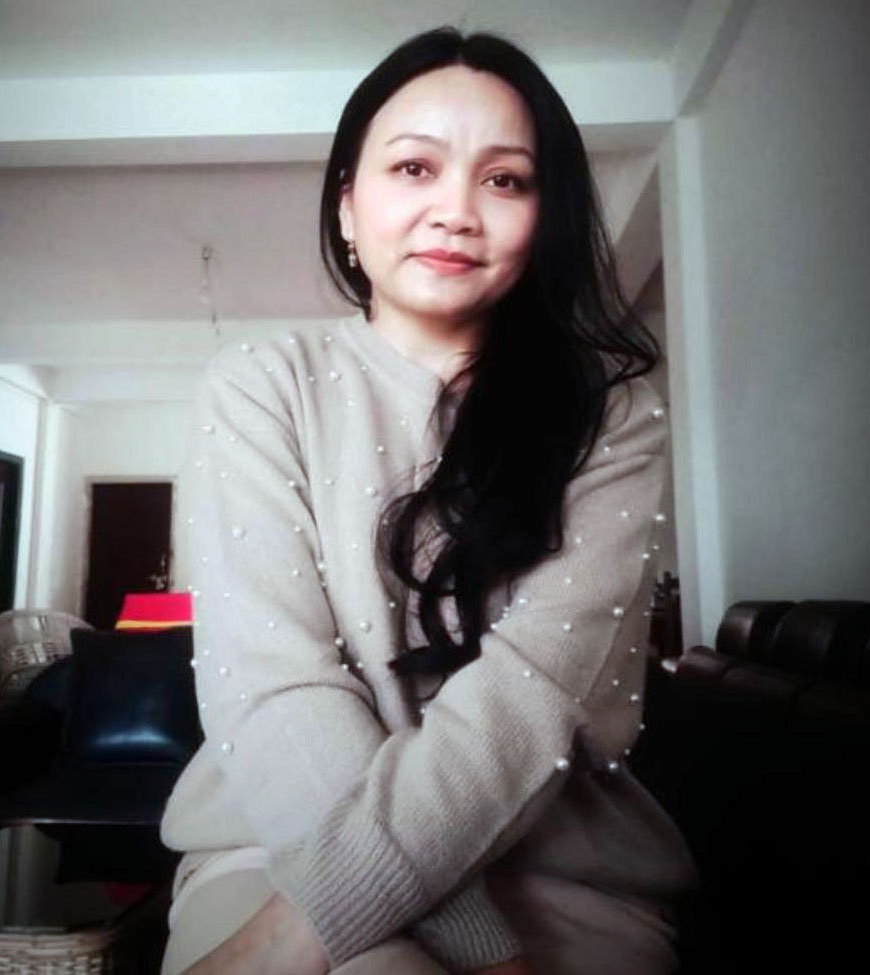
Kenter Joya Riba
(Managing Editor)She is a graduate in Science with post graduation in Sociology from University of Pune. She has been in the media industry for nearly a decade. Before turning to print business, she has been associated with radio and television.
Email: kenterjoyaz@easternsentinel.in / editoreasternsentinel@gmail.com
Phone: 0360-2212313