
-
Mock exercise held in major hospitals of ICR to strengthen…
-
State’s first renal transplant carried out at TRIHMS
-
SIFF voices concerns over SUMP, questions deployment of security personnel
-
Family of deceased school student protest outside Yupia…
-
Tawang Marathon: Khandu launches new logo, official T-shirt
-
APU must aim for greater heights, says new VC Prof.…
-
CM calls high level meeting following ANSU’s 48-hr bandh…
-
Governor visits Armed Forces outreach and awareness enclosures
-
Centre extends AFSPA in three Arunachal districts, few…
-
138 Bn CRPF clinches Inter- Battalion football title in…
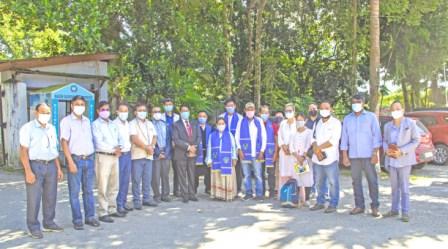
Rono Hills, Sep 13: A 3-day workshop on the language and culture documentation of the Ashing (Adi) community begun today at Rajiv Gandhi University (RGU). The program is being organised by the Centre for Endangered Languages (CFEL), Arunachal Institute of Tribal Studies (AITS), RGU under the project “Documentation of Endangered Languages, Oral Narratives and Cultures of the Lesser-Known Tribal Communities of Arunachal Pradesh” supported by the North Eastern Council (NEC), Government of India.
Ashing (Adi) is one of the least known and undocumented languages under the larger ambit of the Adi ethnic identity of Arunachal Pradesh. This speech variety is spoken only by around 10 speakers who live in Ngereng village, Kuging village, and a few families in the Tuting township under the Tuting administrative Circle of the Upper Siang District, Arunachal Pradesh. Based on the UNESCOs Language Vitality and Endangerment Framework (2003), Ashing can be classified as a moribund language. It is on the verge of extinction since the intergenerational transmission of the language has discontinued and the present speakers are also already old-aged.
During the inaugural program of the workshop, Professor Saket Kushwaha, Vice-Chancellor of Rajiv Gandhi University while welcoming and felicitating the Ashing speakers thanked them for their hospitality towards the research team during their stay in the field. He urged the native speakers to continue speaking their language for intergenerational transmission of the language and document it before it vanishes from this world. The VC also urged the centre to document the language in both textual and digital formats besides developing a video documentary on this speech community.
While citing examples of the third language subjects in school education of Arunachal Pradesh, Dr. N. T. Rikam, Registrar of RGU urged the CFEL in collaboration with the native speakers to develop the language in a book form so that it can be learnt in and out of school by future generations. He stressed the need for looking at the future implications of the language lost and urged the Ashing speakers to adopt strategies to preserve their language before it is lost forever.
The resource person from Ashing Community includes Mrs. Gommang Tamut, Chitut Dawa Danggen, Nuni Siboh and Dongkong Siboh.
While thanking the university, Dawa stated that they have been thinking of a way to preserve the Ashing language so that it can help the future generations to learn the language. He assured to extend every possible help to the RGU research team in the preservation and documentation of their language and culture.
Mrs. Gommang Tamut, who is the only competent Ashing speaker, urged the university fraternity to extend help in the best possible way to preserve their language and culture.
Dugbang Lipir who belongs from Tangam (Adi) community is also attending the program as a language consultant and interpreter. During the interaction program, Lipir who is from Kuging village mentioned that the preservation of any language is a two-way process wherein the efforts of both the native speakers and collaboration agencies like RGU and Governments are essential. He thanked the RGU fraternity for providing this sort of platform and urged them to continue documenting the language and culture of communities like Ashing.
Professor S. Simon John, the Coordinator of the Centre for Endangered Languages (CFEL) and the Principal Investigator (PI) of the research project , introduced the background and the purpose of the workshop. He said that the main purpose of the workshop is to bridge the gap between the University and the communities.
Kaling Dabi, the workshop Coordinator and the Research Associate, Centre for Endangered Languages (CFEL) narrated the month-long fieldwork experiences of the research team in the Ashing villages.
The inaugural programme ended with a vote of thanks by Kombong Darang, Research Associate, CFEL. In his message, he appreciated the university fraternity led by the Vice-Chancellor for arranging an interaction programme for speakers of Ashing, the moribund language variety.
Kenter Joya Riba
(Managing Editor)She is a graduate in Science with post graduation in Sociology from University of Pune. She has been in the media industry for nearly a decade. Before turning to print business, she has been associated with radio and television.
Email: kenterjoyaz@easternsentinel.in / editoreasternsentinel@gmail.com
Phone: 0360-2212313