
-
AAPSU member hurt as situation turns volatile during SIR…
-
NEC completes landmark projects worth over ₹ 82 …
-
Borguli residents seek permanent flood protection as Siang erosion…
-
Governor extends Teachers’ Day greeting
-
DLMC meeting reviews developmental schemes in Tawang
-
Ziro Administration gears up for Ziro Music Festival 2026
-
AIIMS Guwahati, TRIHMS organises systematic review and meta-analysis workshop
-
State Congress stage protest demanding withdrawal of FIR against…
-
AAPSU welcomes APPSC move to implement uniform eligibility criteria in…
-
17 metric tonnes buckwheat sourced from women farmers shipped to…
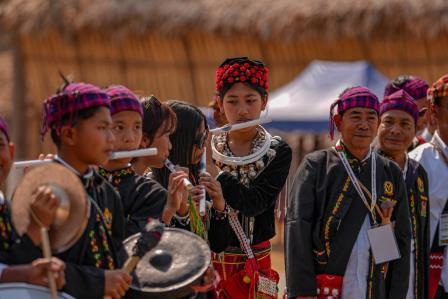
MIAO, Feb 14: Deputy Chief Minister, Chowna Mein joined the vibrant celebration of Shapawng Yawng Manau Poi 2026 at Miao and addressed a large gathering, emphasizing the need to preserve indigenous culture, language, and historical legacy with renewed commitment.
In his address, he stated that the festival is not merely about dance and celebration but begins with sacred and meaningful rituals that connect the community to its ancestral roots. He said such festivals must be purposeful, serving as platforms to reflect on society, heritage, and the responsibility of passing on cultural values to the younger generation.
Highlighting the challenges posed by globalization, the Deputy Chief Minister said that while latest fashion in the markets, modern education, and outside influences cannot be stopped, communities must ensure that they do not lose their identity. “No one will come to preserve our culture, we must protect our culture ourselves,” he said, stressing that language remains the strongest pillar of identity. He called for strengthening indigenous language education in schools with proper implementation and dedicated teachers so that preservation becomes meaningful rather than symbolic.
He also underscored the urgent need to document and digitize ancient manuscripts, oral traditions, folklore, and archival materials using modern technology. Referring to the vision of Prime Minister Narendra Modi, he highlighted the national emphasis on digitization of old manuscripts and preservation of indigenous knowledge systems. He informed that steps are being taken to digitize rare manuscripts and preserve historical documents for future generations.
The Deputy Chief Minister paid floral tributes at Martyr Hill to the Unsung Heroes of the Singpho community, namely, Bom Singpho, Beesa Gaum, Ningru, Luttong Senapati, Duffa Gaum, Set Gaum, and freedom fighter Luttora Gaum. He stated that their sacrifices symbolize courage, dignity, and resistance, and stressed the importance of documenting the contributions of local communities, including their role during the Second World War, so that history is preserved with due recognition.
During his visit, he also toured the Tea and Textile Exhibition, which showcased the rich legacy of the Singpho community. He noted with pride that the discovery of tea in India traces back to the Singpho tribe of the region. In 1823, Robert Bruce received tea plants and seeds from Singpho Chief Beesa Gaum, marking a turning point in the genesis of Assam Tea.
The Singpho Textile Exhibition, a collaboration between the Singpho Women’s Organisation, India and Dr Anna Louise Meynell, recipient of the Nalli Silks MAP Academy research fellowship, highlighted the extraordinary weaving traditions of Singpho women. Using traditional back strap looms, they create vibrant handwoven textiles with symbolic geometric motifs inspired by nature. He remarked that weaving is not merely a craft but a lifeline of society and an enduring expression of identity and resilience.
The Deputy Chief Minister remarks that it is quite fulfilling to see today’s young generations wearing traditional attires with pride and confidence. He concluded by urging the youth to actively participate in cultural preservation efforts so that the legacy handed down by forefathers continues to thrive for generations to come.
The festival was also attended by Minister Biyuram Wahge, MLAs Kamlung Mossang, Ninong Ering, Chau Zingnu Namchoom, Laisam Simai and others.
Kenter Joya Riba
(Managing Editor)She is a graduate in Science with post graduation in Sociology from University of Pune. She has been in the media industry for nearly a decade. Before turning to print business, she has been associated with radio and television.
Email: kenterjoyaz@easternsentinel.in / editoreasternsentinel@gmail.com
Phone: 0360-2212313