
-
CM calls high level meeting following ANSU’s 48-hr bandh…
-
Governor visits Armed Forces outreach and awareness enclosures
-
Centre extends AFSPA in three Arunachal districts, few…
-
138 Bn CRPF clinches Inter- Battalion football title in…
-
Governor commends the pivotal role of 101 Area
-
Drug awareness programme held at APU
-
Governor attends Ziro Music Festival
-
Governor extends Ke Meh Ha festival greetings
-
SUMP: Arunachal Cabinet forms high-level committee to oversee PFR…
-
One of the most significant reforms in public recruitment,…
Maksam Tayeng
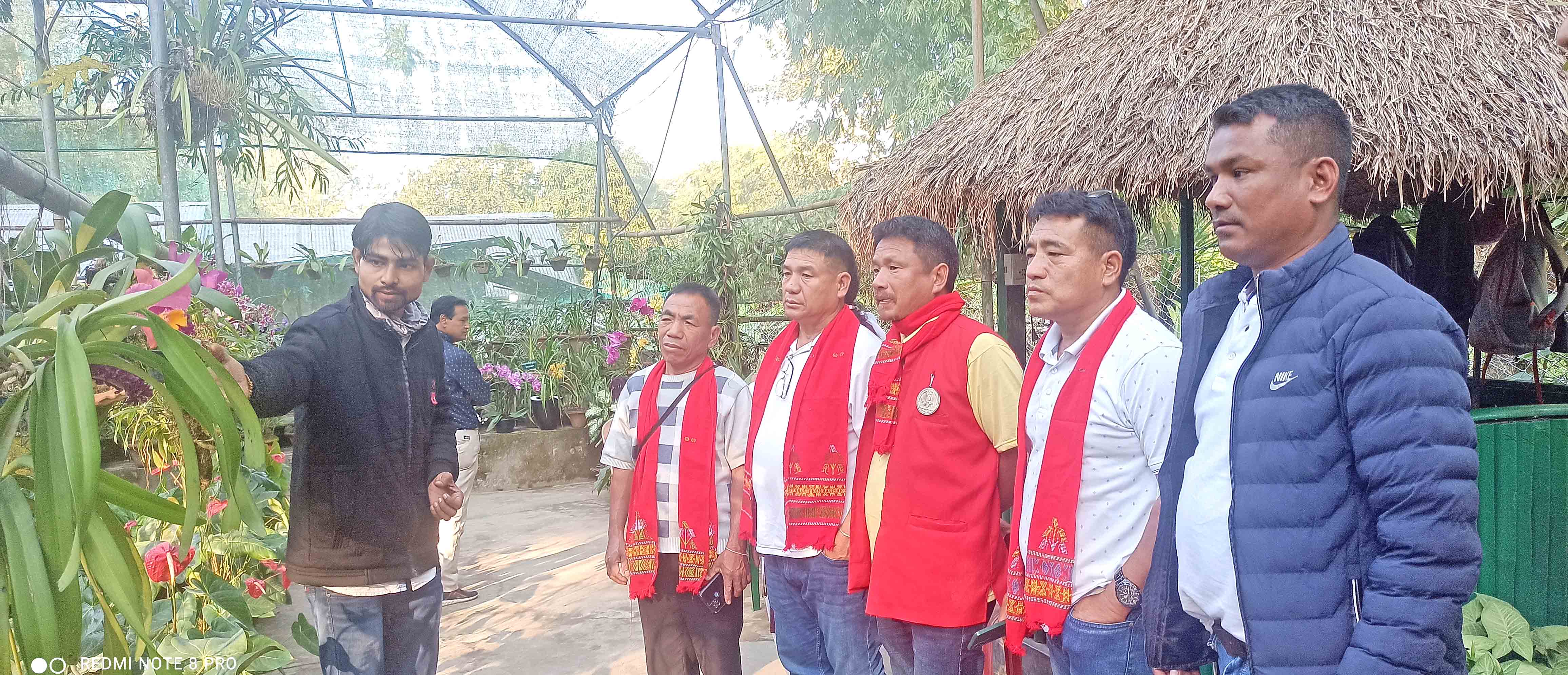
PASIGHAT, Jan 15: The Eco-Development Committee (EDC) members of D. Ering Memorial Wildlife Sanctuary comprising of its executive members and village heads along with few officials visited Kaziranga National Park and nearby Karbi village in Karbi Anglong Autonomous Council to learn about community based tourism and natural resource management.
The 10-member team led by T. Taga, DFO, D. Ering WLS and M. Tayeng, EDC head visited the Karbi villages on a 4 day exposure tour cum a one day orientation meeting. The team learnt about community mobilization, community engagement, NRM and conservation livelihood, principle of community based eco-cultural tourism with reference to KRB experiments. The team also visited traditional Karbi villages and interacted with Homestay owners to start the same in D. Ering WLS and also learnt about making handmade tea and its processing etc. The visit to Karbi villages like Chandrasing Rongpi, Phumen Engti, Hemai Lakthe and Bakring Engti and their success in Homestay operation from tourism coming out of Kaziranga National Park and Orchid Park of Kohra were a worthwhile experience for the team.
Interacting with the team from D. Ering WLS, the DFO Kaziranga, Ramesh Gogoi shared the challenges faced by the officials and field staff and opined how similar techniques and plans could be used in controlling challenges in the D. Ering WLS.
Earlier on 9th January, the team attended an orientation meeting organized by legal and advocacy division (LAD) of scientific and industrial research organisation Aaranyak which has chalked out a pilot strategy to set up community surveillance and monitoring teams (CSMT) to facilitate community participation in the conservation process as well as wildlife crime prevention in and around the D. Ering WLS. Team Aaranyak led by its CEO, Bibhab Kumar Talukdar was much appreciated for extending their full support in improving the eco-tourism and community surveillance and monitoring in and around the D. Ering WLS.
It is to add here that, despite the D. Ering WLS being around 45 years old after its official notification in the year 1978, the sanctuary hasn't been useful for the fringe villages due to unrestricted hunting and poaching in the sanctuary. No tourism and benefits to villagers surrounding the sanctuary were initiated by the sanctuary management till date. But after the sanctuary has been improved from its basic protection, the eco-tourism measures are now being taken up so that the local community also earn their livelihood from the tourism flow in the sanctuary along the lines of Kaziranga National Park. The livelihood support to the local community from the tourism flow in the sanctuary will directly and indirectly help in protection of the sanctuary in days to come.

Kenter Joya Riba
(Managing Editor)She is a graduate in Science with post graduation in Sociology from University of Pune. She has been in the media industry for nearly a decade. Before turning to print business, she has been associated with radio and television.
Email: kenterjoyaz@easternsentinel.in / editoreasternsentinel@gmail.com
Phone: 0360-2212313